
Jumpstarter amps & capacity: what do you really need?
You get in the car in the morning, turn the key... nothing. The battery is dead. Then you want one thing: to be sure your jump starter has enough power. But how many amps do you really need? And how do peak current and capacity relate to each other? In this guide, we, as specialists, clearly explain how to choose a jump starter based on amps, engine type, temperature, and usage. We'll point you along the way to the correct categories for car jump starters , truck jump starters , and motorcycle jump starters .
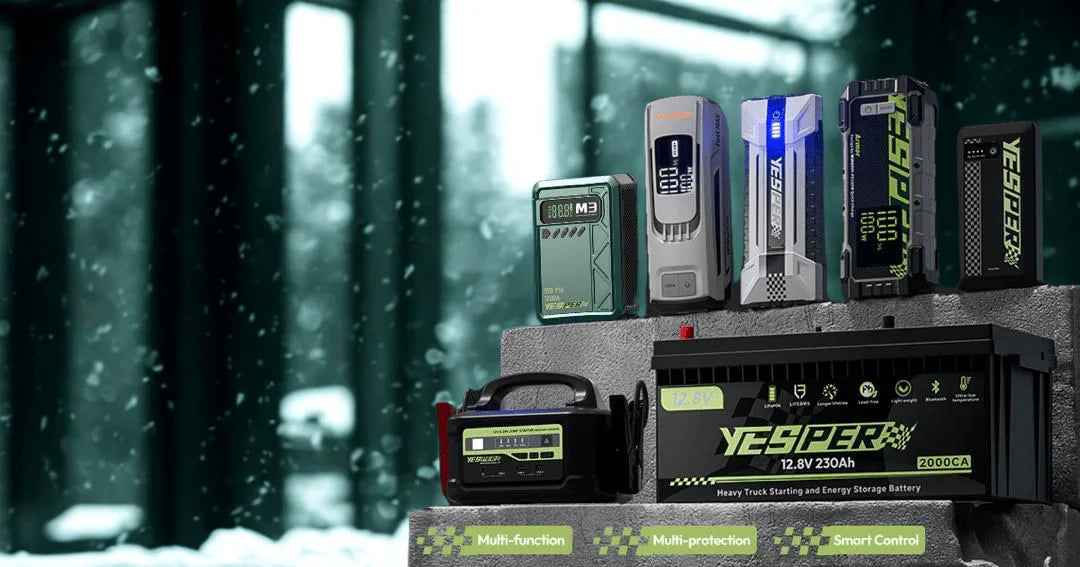
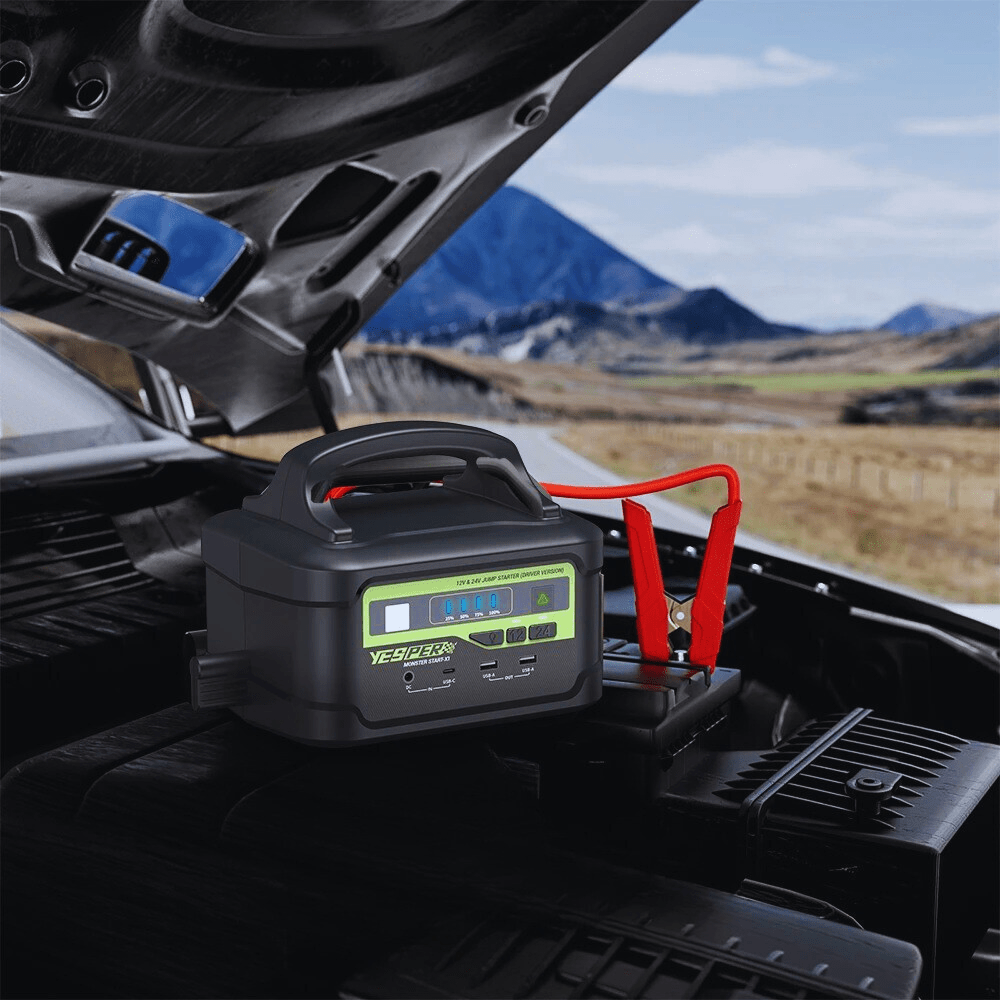
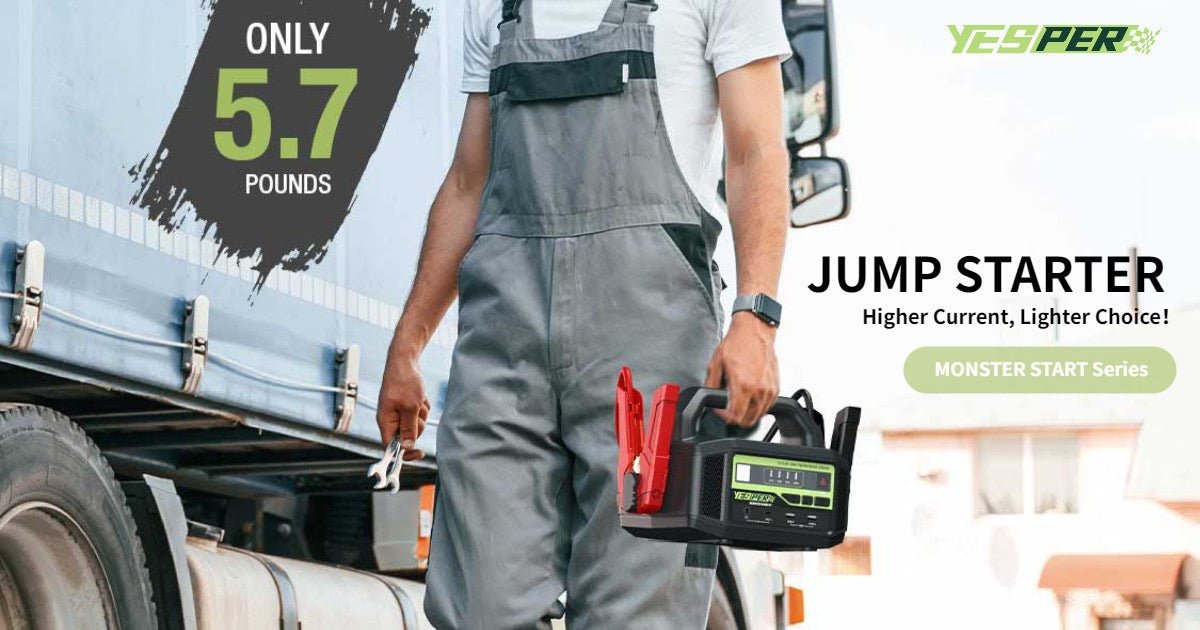
Brands like Yesper are known for their powerful and safe models. The Yesper Monster Star N1 is a prime example: high peak current, smart protection, and practicality.
Basics: Why Amps and Capacitance Matter
What is peak current / starting current?
Peak current (also known as "starting current") is the maximum number of amps the jump starter can deliver for a very short time to get the starter motor moving. This is the number you're looking for when starting. If the peak current is too low, the starter motor will turn too slowly or not at all.
Capacity: mAh, Ah and Wh
Capacity indicates how much energy the jump starter can store. Manufacturers express this in mAh/Ah (current × time) or in Wh (energy). Capacity primarily determines how often you can try a jump starter and whether you can also use it as a power bank. Peak current is more important for starting the jump starter itself.
Peak current vs. continuous flow
Note the difference: peak current is a short burst during start-up; continuous current is what a device can deliver over a longer period. For cars, motorcycles, and vans, this peak current is crucial.
Differences per engine: petrol, diesel, 24V
Petrol engines
Gasoline-powered passenger cars often start with a peak current of 400–700 A , depending on the displacement, compression, and condition of the battery. For most users, a good car jump starter within this range is sufficient.
Diesel engines
Diesel has higher compression and therefore requires more starting current: often 800–1,200 A for 2.0–3.0 L. Do you drive a lot of short distances, have an older battery, or often start in the cold? Choose extra margin.
Van, camper and truck (24V)
For heavier vehicles and 24V systems, you'll need a more powerful category. Think 1,500–2,500 A peak, depending on engine size and conditions. View the truck jump starter category (24V) here.
The role of temperature & battery condition
Cold reduces the chemical activity in batteries: internal resistance increases, and the available current decreases. Consequently, you often need more peak current to get the engine started. An old or (deeply) discharged battery also places greater demands on your jump starter.
- Winter tip: allow for a margin of +30–50% on the theoretically required peak current.
- Storage: Store your jump starter indoors or insulated from frost; recharge it after use.
Calculation scheme: how to determine your minimum peak flow
Use this simple chart as a starting point (for guidance only, always choose something a little wider):
- Determine engine type and capacity (petrol/diesel, litres).
- Use the guideline in the table below (normal conditions).
- Add margin for cold starts, old battery or heavier load: +30–50% .
Quick formula
Aanbevolen piekstroom (A) ≈ basiswaarde uit tabel × (1 + marge)
Example (2.0 L diesel, base 1,000 A, winter margin 40%): 1,000 × 1.40 ≈ 1,400 A .
Table: Recommended peak current per vehicle type
| Vehicle type | Engine capacity / system | Recommended peak current (A) | Remark |
|---|---|---|---|
| Motorcycle | < 1.0 L (12V) | 200–400 | Compact jump starter motor is sufficient |
| Car gasoline | 1.0–2.0 L (12V) | 400–700 | Standard car jump starter |
| Car diesel | 2.0–3.0 L (12V) | 800–1,200 | Margin in cold/older battery |
| Van/Camper | 3.0–4.0 L (12V) | 1,000–1,500 | Pay attention to cable thickness and clamp quality |
| Truck | > 4.0 L (24V) | 1,500–2,500 | View truck jump starter |
Real-world example: Yesper Monster Star N1
The Yesper Monster Star N1 is often chosen by drivers who want reliability in a variety of conditions. The combination of a high peak current, protective circuits (against reverse polarity, short circuits, and overheating), and practical extras (flashlight, power bank) makes it a strong all-rounder. Yesper is known as one of the better brands in this segment.
Safety: How to jumpstart correctly
- Switch off the ignition and consumers (lights, radio).
- Connect + to + (battery/positive point) and – to ground/negative point.
- Check that the jump starter is stable and that the cables are not kinked.
- Start the engine. If it doesn't start within a few seconds, wait a few seconds and try again.
- Disconnect in reverse order and allow the engine to charge.
Preferably choose a model with reverse polarity protection , temperature monitoring and sturdy clamps.
Summary & selection advice
- Peak current is crucial for starting; capacity mainly determines how often you can try or charge.
- Petrol (1.0–2.0 L): 400–700 A. Diesel (2.0–3.0 L): 800–1,200 A. Heavier/24V: 1,500–2,500 A.
- In winter or with older batteries, count on a margin of +30–50% .
- Brands like Yesper provide powerful, safe and compact solutions (e.g. Monster Star N1).
Quick tip: determine your base value from the table, add margin and then choose a model in the correct category: car jump starter , truck jump starter or jump starter motorcycle .
FAQ
How many amps of jump starter do I need for a 2.0L diesel?
Aim for 1,000–1,200 A peak current and add 30–50% for cold starts. Check the car jump starter category for 12V or, for heavier diesel engines, the 24V truck jump starter .
What's more important: amps or capacity (mAh/Ah)?
Amps (peak current) are crucial for effective starting. Capacity determines how many starting attempts and how many power bank connections are possible.
Does a jump starter also work well in frost?
Yes, provided you allow for sufficient peak current and margin. Keep the device warm, charge it, and choose a model that performs well in cold conditions.
Read more: our comprehensive guide to the best jump starters with test results.
View our 2025 jump starter buying guide
All jump starters | Car jump starters | Truck jump starters | Motorcycle jump starters